

Introduction
The first few weeks of a school year can be a blur.
You’re learning new names, settling into schedules, getting to know students, attending meetings, managing documentation, and figuring out how everything is actually going to work.
Once that initial rush settles, you also start to get a much clearer picture of the job you accepted.
Your caseload may look reasonable on paper, but everything around it takes more time than expected. Your schedule may still be shifting. You may be covering more buildings, taking on responsibilities you didn’t anticipate, or realizing that the support you expected isn’t really there.
Some of that comes with the territory. School-based work is demanding, and every year has difficult stretches.
The question is whether things are starting to settle into a workable rhythm or whether the role is asking more from you than you can realistically sustain.
If you’re a Special Education teacher, School Psychologist, BCBA, SLP, OT, or another school-based professional, here are seven things worth paying attention to.
First, Look Beyond Your Caseload
When people talk about school-based workload, the conversation often starts with a number.
How many students are on your caseload?
That’s important, but it rarely tells the whole story.
For an SLP, for example, the American Speech-Language-Hearing Association distinguishes between caseload and workload. Caseload refers to the students being served, while workload includes everything required to serve them, including direct services, planning, assessments, meetings, documentation, collaboration, communication, compliance responsibilities, and other duties.
That concept applies well beyond speech-language pathology.
A Special Education teacher’s workload includes much more than classroom instruction. A School Psychologist may be balancing assessments, reports, consultations, meetings, and student support. An OT may be providing direct services while also collaborating with teachers and families, documenting progress, planning interventions, and traveling between schools. A BCBA may be observing students, reviewing data, developing behavior plans, consulting with teams, training staff, and following up on interventions.
Caseload tells you who you serve.
Workload tells you what it takes to serve them well.
7 Signs It’s Time to Take a Closer Look at Your Role
A difficult day is not necessarily a problem. Neither is an unusually busy week.
What matters are the patterns.
1. There Isn’t Enough Time for the Work You’re Expected to Do
Start with a basic question: Can the responsibilities of your job reasonably fit into the time you’re given to do them?
Direct student support may be only one part of your day. There may also be IEPs, evaluations, documentation, planning, meetings, consultation, progress monitoring, family communication, compliance work, and travel between locations.
ASHA’s current workload guidance encourages school-based SLPs to measure all of those responsibilities against their available work hours rather than looking only at the number of students served.
AOTA has made a similar case for school-based Occupational Therapy practitioners, noting that a traditional caseload-only approach can overlook the broader responsibilities required to effectively serve students.
If you are consistently choosing between serving students well and completing everything else you’re responsible for, that deserves a closer look.
2. Your Role Keeps Expanding
School needs change. Flexibility is part of working in education.
But there’s a difference between occasionally pitching in and watching your role steadily become something different from the position you accepted.
Maybe you’ve picked up another campus. Your caseload has grown significantly. You’re regularly covering duties outside your primary role. Or responsibilities that were described as occasional now take up a meaningful part of your week.
Ask yourself:
If I were considering this job today, knowing what I know now, would I still accept it?
If the answer has changed, it’s worth understanding why.
3. You Don’t Have the Support You Need
No Special Education professional works in isolation.
Teachers rely on related service providers, paraprofessionals, administrators, families, and other members of the IEP team. SLPs, OTs, BCBAs, and School Psychologists depend on collaboration with educators and school leadership to turn recommendations into meaningful support for students.
When that collaboration works, even demanding jobs can feel manageable.
When it doesn’t, even a reasonable workload can become much harder.
Consider whether you have people you can turn to when questions come up. Do you have access to the resources you need? Can you raise concerns? Does leadership respond? Are team members able to collaborate, or does everyone seem stretched too thin?
Support isn’t a nice extra. It’s part of what makes good work possible.
4. Work Regularly Follows You Home
There will always be weeks when you stay late, finish something at home, or spend extra time preparing for an important meeting.
The question is whether that’s the exception or the expectation.
If documentation, reports, planning, evaluations, or other responsibilities routinely spill into evenings and weekends simply because there isn’t enough time during the workday, look at the pattern rather than treating every week as an isolated problem.
That’s particularly important because working conditions matter for retention. A March 2026 Learning Policy Institute analysis found that teacher turnover is associated with factors including salary, supportive leadership, and job and workplace satisfaction. The analysis also found higher turnover among Special Education teachers than many other teaching groups.
A sustainable role can still be demanding. The difference is whether the workload is realistic enough to maintain over time.
5. Too Much of Your Time Goes to Everything Except Your Actual Work
Every school-based role comes with documentation, meetings, planning, and administrative responsibilities. That’s part of the job.
But there’s a point where those responsibilities can start crowding out the work you’re actually there to do with students.
If you’re regularly struggling to find enough time for instruction, therapy, assessment, intervention, consultation, or other work that requires your expertise, pay attention to that. The issue may not be your profession. It may be how this particular role is structured.
6. You’re Missing the Clarity You Need
Sometimes the hardest part of a role isn’t workload. It’s uncertainty.
Who decides priorities when everything feels urgent? What exactly falls within your responsibilities? Who should you go to when circumstances change? What support is available? How are concerns handled?
Clear expectations make demanding work easier to navigate.
If you’re constantly guessing, reacting, or finding out about responsibilities after they’ve already landed on your plate, the problem may be less about the amount of work and more about how the role is structured.
7. You’re Already Thinking About What Else Is Out There
Pay attention to that.
It doesn’t automatically mean you should leave your job. But if you repeatedly find yourself looking at openings, wondering about another school, or imagining what it would be like to work somewhere with a different schedule, workload, team, or level of support, there may be something worth exploring.
You don’t have to wait until you’re completely burned out to ask whether another environment could fit you better.
Not Sure Whether It’s the Job or the Environment
Sometimes it helps to talk it through with someone who understands school-based Special Education roles.
Navra works exclusively in Special Education Staffing & Services. Our recruiters talk with teachers, SLPs, OTs, School Psychologists, BCBAs, and other school-based professionals every day, so we understand how much the details behind a job title can matter.
You don’t have to be ready to make a move to start a conversation.
What’s Normal Back-to-School Stress and What’s a Bigger Issue?
The beginning of the school year is rarely calm.
New schedules take time to settle. Caseloads change. Meetings pile up. Teams are learning how to work together. Processes that felt confusing in September may feel completely normal by November.
So how do you know whether something is temporary?
A useful starting point is to look for patterns instead of individual bad days.
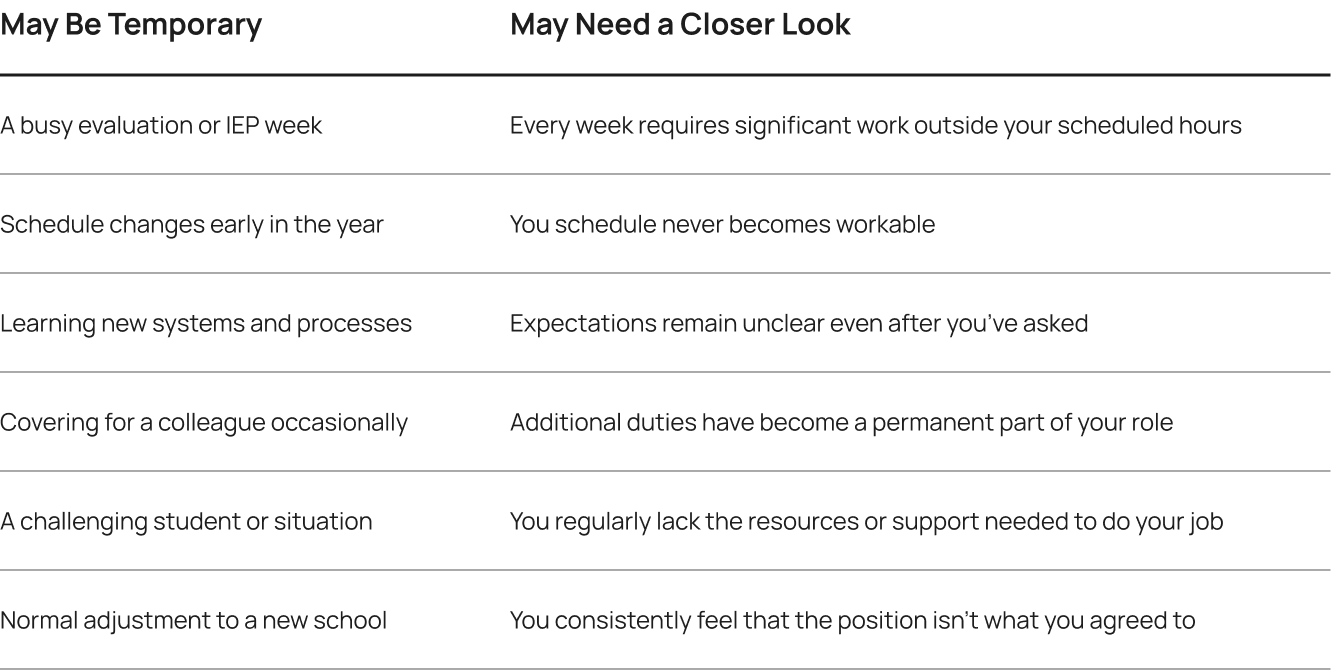
No school-based job is free of challenges. The important distinction is whether the pressure is temporary or built into the role.
Before You Decide What Comes Next, Get Specific
If something isn’t working, try to identify what it actually is.
Ask yourself:
- Is the issue my total workload or one specific responsibility?
- Has my caseload or assignment changed since I started?
- Am I getting enough support from leadership and my team?
- Do I understand what I’m responsible for?
- Can most of my work be completed during the hours I’m expected to work?
- Is there something that could realistically change and make this role work better?
- What would I want to be different in my next opportunity?
“I need one campus instead of three,” “I want a different student population,” “I need clearer expectations,” or “I want more predictable hours” gives you something much more useful to work with.
Before asking, “Should I leave?” ask, “What would need to be different for this role to work for me?”
You May Not Need a Different Career. You May Need a Different Fit.
When a job becomes overwhelming, it’s easy to start questioning the career itself.
But if you still enjoy working with students and believe in the work you’re doing, the profession may not be the problem. The environment may simply no longer be the right fit.
School-based roles can look very different from one district to another.
One district may mean one campus. Another may require travel.
One role may come with a highly collaborative team. Another may offer more independence.
Schedules, student populations, caseloads, responsibilities, resources, leadership, and support can all vary.
That’s why evaluating your next opportunity should go beyond the title.
What Should You Ask About Your Next School-Based Opportunity?
When you’re comparing school-based Special Education jobs, use what you’ve learned from your current experience to ask better questions.
Caseload and Workload
How many students will you support? What other responsibilities come with the role? How much time is built in for documentation, planning, evaluations, meetings, and collaboration?
Schedule and Location
Will you work at one school or several? How much travel is involved? What does a typical week look like?
Team and Support
Who will you work with? Who will you report to? What other Special Education professionals are on the team? Where do you go when you need help?
Why the Position Is Open
Is the role new? Is the program growing? Did someone relocate? Has the position been difficult to retain?
What Can Change
Caseloads and school needs evolve. Ask how changes are communicated and what happens when responsibilities shift during the school year.
The more you understand before accepting a role, the less likely you are to discover important details after you’ve already started.
What the Right Special Education Staffing Partner Can Add
If you decide to explore other opportunities, you don’t have to figure out all of those details by yourself.
Navra is a Staffing & Services partner focused exclusively on Special Education. That focus matters because a Special Education teacher, School Psychologist, BCBA, SLP, and OT can all work in a school setting and still need very different things from a role.
Our recruiters start by understanding what you’re looking for, then help you explore opportunities that fit. We want to know what worked in your current role, what didn’t, the students you enjoy supporting, the schedule that works for your life, and the type of team and support that help you do your best work.
From there, we can help you dig into the details behind an opportunity. What does the workload really look like? How many schools will you cover? What support is available? Why is the position open? What happens if the assignment changes?
The goal is not simply to find a job you’re qualified to do. It’s to help you find an opportunity that makes sense for the professional you are and what you need next.
And that support continues after you accept an assignment. From the initial conversation through placement and beyond, you have a Navra recruiter who stays connected and invested in your success.
Your Job Should Support the Work You’re There to Do
Special Education professionals take on demanding work because the work matters. But caring deeply about students doesn’t mean every workload, schedule, school, or environment will be right for you.
If this school year is already showing you that something isn’t working, get specific about what you would want to change. You may realize that you still love the work, but need a different environment to do it well.
If you’re ready to see what that could look like, Navra can help you explore your options.
Let’s Find a Role That Fits the Way You Want to Work
Explore school-based opportunities with a Navra recruiter who understands Special Education and takes the time to understand what matters to you.