
Choosing your next school-based role involves more than deciding where you want to work.
If you’re a Special Education teacher, School Psychologist, Board Certified Behavior Analyst (BCBA), Speech-Language Pathologist (SLP), or Occupational Therapist (OT), your next job can affect your caseload, schedule, compensation, support, commute, and the students you work with every day.
One of the biggest decisions you may face is whether to work directly for a school district or take a contract position through a staffing partner.
For many Special Education professionals, district employment is the path they know best. But familiar does not always mean best for where you are in your career today. Contract work offers another way to build a meaningful school-based career, with more opportunity to compare roles, understand expectations upfront, and have someone advocating for what matters to you.
Both paths have advantages. The key is understanding what you’re gaining, what you’re giving up, and which option gives you more of what you want from your work right now.
District vs. Contract Special Education Jobs: The Short Version
Looking for a quick comparison? Start here.
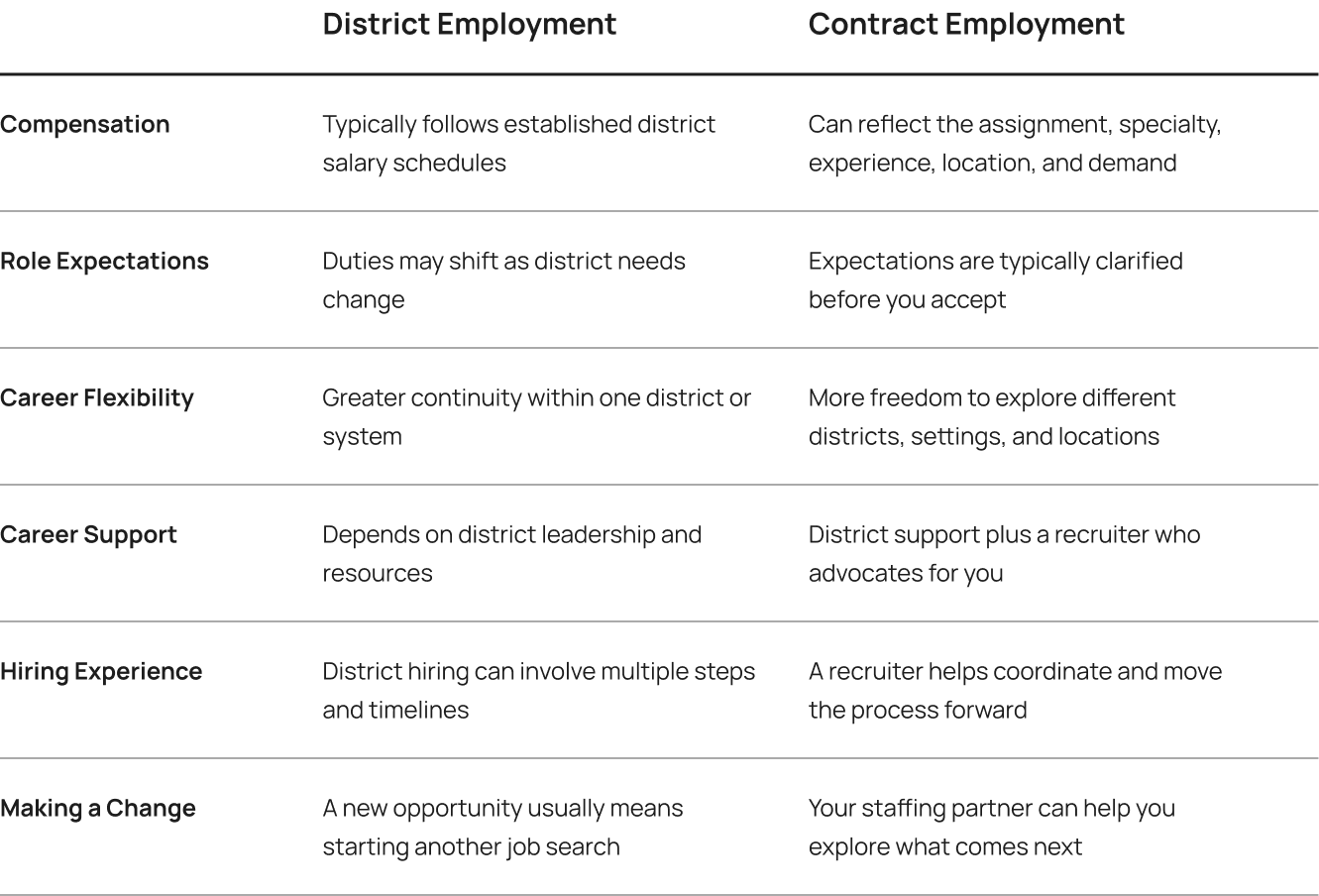
The takeaway: District employment offers familiarity and continuity. Contract work can give you more choice, more clarity before you commit, and another person advocating for you throughout the experience.
Not sure which path fits what you’re looking for?
Tell us what’s important to you. A Navra recruiter can help you explore school-based opportunities, compare your options, and decide what makes sense for you.
What to Consider About Working Directly for a School District
District employment can offer consistency, established benefits, and the chance to become part of one school community. That structure can also come with less flexibility as your priorities change.
Stability Can Mean Less Flexibility
Working directly for a district can provide continuity and the opportunity to build long-term relationships with students, families, and colleagues.
The tradeoff is that your role, location, compensation structure, and career path are tied to that district. If you want something different, making a change often means starting a new job search.
Salary and Benefits Follow an Established Structure
District positions typically follow set salary schedules and may include health insurance, paid leave, retirement programs, and other benefits.
Those benefits can be valuable, especially if you plan to stay within the same system long term. But a fixed salary structure may offer less flexibility to reflect current demand, hard-to-fill specialties, or the experience you bring to the role.
District Needs Can Shape Your Role
Schools have changing student and staffing needs, and your responsibilities may shift with them. Caseloads, schedules, campus assignments, or additional duties can change over time.
As a district employee, you typically navigate those changes within the school system. With a contract role, you also have a staffing partner who can help clarify expectations upfront and serve as another resource if circumstances change.
Why More Special Education Professionals Consider Contract Work
Contract work gives Special Education professionals another way to build a school-based career. Depending on the opportunity, it can offer more choice, greater clarity before you commit, competitive compensation, and a recruiter who stays in your corner.
More Choice in Where and How You Work
Your priorities may change throughout your career.
An SLP may want to work with a different age group. A School Psychologist might be looking for a different service model. A Special Education teacher may be relocating. A BCBA or OT coming from another setting may want to explore school-based work.
Contract opportunities can make it easier to consider different districts, locations, student populations, and work environments.
Your next job does not have to look like your last one.
More Clarity Before You Say Yes
A job title only tells you so much.
Before accepting a role, you’ll want to understand the schedule, student population, caseload or workload, campus locations, responsibilities, leadership, and available support.
A recruiter who knows the opportunity and understands your profession can help you get those answers upfront. That gives you a clearer picture of what the job may actually look like before you decide whether it’s right for you.
Someone Advocating For You
One of the biggest advantages of working with the right staffing partner is having someone focused on what matters to you.
At Navra, that starts with listening. Your recruiter wants to understand your preferred student population, commute, schedule, compensation goals, school environment, and the kind of support you’re looking for.
From there, we can help you evaluate opportunities, prepare for interviews, navigate onboarding, and stay connected after your assignment begins.
If something changes during the school year, you have another person to call.
That’s what a staffing partnership should feel like.
Contract Work May Be a Strong Fit If You:
- Want to explore different districts or school environments
- Feel limited by a traditional district salary structure
- Want more clarity about an assignment before accepting it
- Are relocating or considering a new geographic market
- Want to work with a different age group, student population, or service model
- Are moving into school-based work from another setting
- Want recruiter support during your search and throughout your assignment
- Value having someone who can advocate for your priorities
- Want more flexibility as your career or life changes
You don’t have to be unhappy in your current job to explore something different. Sometimes you’re simply ready for a role that fits you better.
What About Pay and Benefits?
Pay is understandably one of the first things professionals compare, and it is one area where district and contract employment can work differently.
District compensation typically follows an established salary schedule based on factors such as education and years of experience. That provides predictability, but it can leave less room for compensation to reflect a hard-to-fill specialty, local demand, or the specifics of an individual opening.
Contract compensation is often tied more closely to the assignment itself. Your discipline, experience, credentials, location, schedule, and district need can all play a role.
That does not mean every contract position will pay more. It means the compensation is worth comparing.
Benefits matter too. District positions may include health insurance, paid leave, retirement programs, and other established benefits. Staffing firms may offer benefits as well, but availability and eligibility can vary.
The best comparison looks at the full opportunity, not just one salary or hourly rate.
Questions Worth Asking
Before comparing two opportunities, find out:
- What is the pay structure?
- How many days or hours are included?
- What benefits are available?
- How are school breaks handled?
- What happens during the summer?
- Will I work at one school or travel between locations?
- What responsibilities are included in the role?
- Who can I turn to if something changes during the school year?
“Don’t Compare Paychecks. Compare the Whole Opportunity.”
Compensation matters, but so do your schedule, benefits, responsibilities, commute, support, and the environment you’ll be working in every day.
A Navra recruiter can help you look at those details together so you understand what an opportunity really offers.
Special Education Professionals Continue to Be in Demand
Schools across the country continue to need qualified Special Education professionals.
According to a July 2026 analysis from the Learning Policy Institute, at least 425,412 teaching positions nationwide were either unfilled or filled by teachers who were not fully certified for their assignments, representing roughly 1 in 8 teaching positions. Special Education was the most commonly reported shortage area, with 45 states reporting shortages in the field.
Demand extends to specialized professionals as well. Current U.S. Bureau of Labor Statistics projections show 15% employment growth for Speech-Language Pathologists and 14% growth for Occupational Therapists from 2024 to 2034.
BCBA demand also remains strong. The Behavior Analyst Certification Board’s 2026 employment-demand report identified 132,307 U.S. job postings in 2025 that required or preferred BCBA or BCBA-D certification.
These figures are not specific to school-based positions in every case, but they reinforce an important point: your skills are needed. That gives you a reason to be thoughtful about where you put them to work.
1 in 8 teaching positions nationwide are estimated to be unfilled or filled by teachers who are not fully certified for their assignments.
Source: Learning Policy Institute, July 2026
Five Questions to Ask Before Accepting Any School-Based Job
Whether you’re interviewing directly with a district or considering a contract assignment, the job description only tells you part of the story.
Before saying yes, ask:
1. What Will My Day Actually Look Like?
Ask about the schedule, student population, caseload or workload, campus locations, team structure, and responsibilities.
2. What Support Will I Have?
Find out who you’ll work with, who you can turn to when questions come up, and what collaboration looks like within the Special Education team.
3. Why Is the Position Open?
Is it a new role? Is the program growing? Did someone relocate? Has the position been difficult to fill or retain?
The answer can give you useful context about the opportunity.
4. What Does Success Look Like?
Ask what the district hopes the person in this role will accomplish during the first semester or school year. This can reveal expectations that may not appear in the job description.
5. Is This a Job I Actually Want?
It’s easy to spend an interview proving you’re qualified. Make sure you’re evaluating the opportunity too.
Think about the workload, students, team, support, compensation, commute, schedule, and expectations. Do those things line up with what you want?
These questions are not always easy to answer from a posting or first interview. A Navra recruiter can help you understand the opportunity and know what to ask before making a decision.
We’re not only looking at whether your experience matches the job. We’re helping you determine whether the job matches what you’re looking for too.
The right opportunity should be a fit in both directions.
Your experience should meet the school’s needs, and the role should meet yours.
Why Explore Contract Opportunities With Navra?
Not every staffing partner approaches Special Education the same way.
Navra focuses exclusively on Special Education Staffing & Services.
We work with Special Education teachers, SLPs, OTs, School Psychologists, BCBAs, and other school-based professionals every day. We understand that two positions with the same title can come with very different schedules, student populations, expectations, and support.
That’s why our conversations start with what you’re looking for.
Maybe you want a shorter commute, more predictable hours, a different student population, better compensation, stronger support, or the chance to try a new environment.
Once we understand your priorities, we can help you explore opportunities with those priorities in mind.
And our support does not disappear when you accept an assignment. We stay connected because a successful placement is about more than starting the job. It’s about having the support to succeed once you’re there.
You May Have More Options Than You Think
You don’t have to leave school-based work to find something different.
Sometimes the change you’re looking for is a different district, assignment, schedule, environment, or employment model.
If you’ve only considered direct district positions, exploring contract Special Education jobs can show you what else is available. You may find an opportunity with the compensation, support, flexibility, or day-to-day experience you’ve been looking for.
Tell Navra what you’re looking for. We’ll help you explore the opportunities, understand the details, and decide what feels like the right fit.
See What a Different Kind of School-Based Role Could Look Like
Explore Special Education teacher, School Psychologist, BCBA, SLP, OT, and other school-based contract opportunities with Navra.